
REAL RUNS
Real businesses. Real runs.
Real local businesses, each starting with a score between 11 and 35. See them live — click any one. Below, what every run built and what it caught.
// See them live
Sites we built. Each its own brand — not a template.

RUN 01 — NEPA TREE CARE
19/100
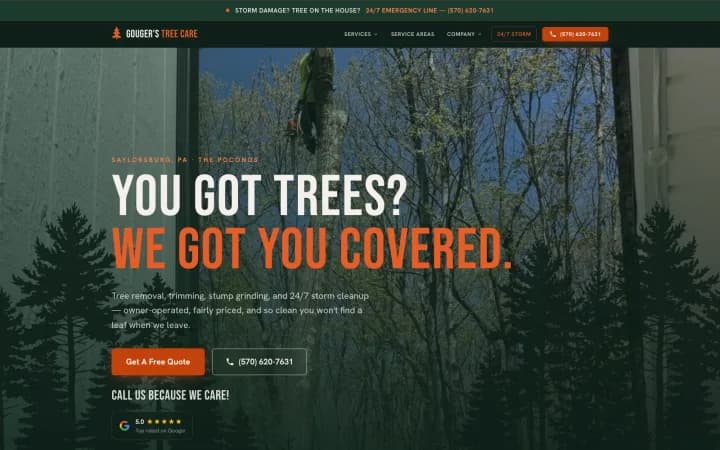
No website. Just a Facebook page and a bucket truck.
The business had been running for several years with no web presence at all — their digital footprint was a Facebook page. They had a top-rated Google profile that had never been claimed, and a GBP listing pointing to the wrong town on every aggregator.
What the run built
- 279 full-resolution job photos downloaded from Facebook before a word of copy was written.
- The GBP address error caught and corrected — the listing had pointed to the wrong town for years.
- 32 routes deployed. Service pages for every offering. Eight location pages — one per town served.
- A blog with four posts written for AI search; a gallery of 52 curated real photos; a 9.8-second hero video filmed from their own job photos. Live load time: 1.94 seconds, measured.
- The scroll centerpiece: a hand-built pine tree that grows as you scroll — trunk clips up, five bough tiers spring in, milestone labels appear on the branches, an ember star when you reach the top. Built from the client's own Facebook photos.
- A complete Google Business Profile package: keyword-rich description, five correctly matched categories, four GBP posts, ten Q&A seeds, a photo checklist.
What QA caught before launch
104 confirmed issues in the adversarial review. The most consequential: every piece of JSON-LD on the site had been silently misfiled. The schema keys didn't match the actual page slugs — meaning structured data on all four blog posts had never rendered. Google couldn't see it. No one would have known until rankings didn't move. The bug was found, corrected, and verified before the site went live.
RUN 02 — POCONO SHORE EXTERIOR CLEANING
23/100
The "website" was a parked ad lander.
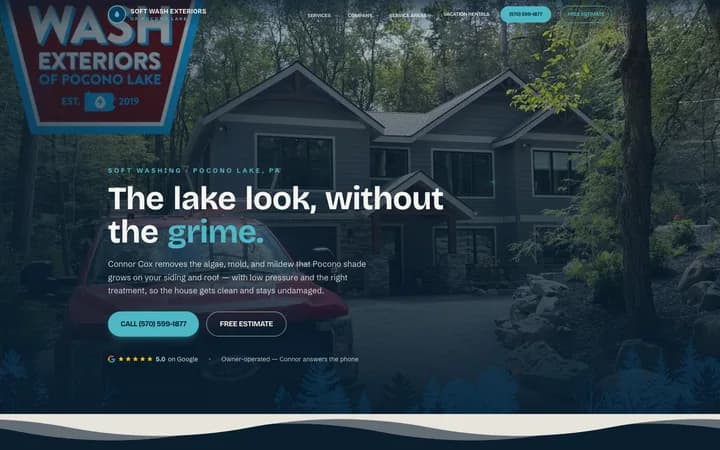
The business's website field in a professional directory linked to a GoDaddy ad lander — a registered domain with zero content ever hosted on it. The business had 55 Instagram followers and a posting cadence that showed real work, none of it driving anywhere because there was no site to send people to.
What the run built
- Stage 0 catch: the parked lander identified before strategy was written. The optimization guide flagged the parked domain still listed in the GBP, actively damaging trust with anyone who clicked.
- Authenticated social ingestion: 120 Instagram posts and 30 Facebook images archived before the build. The research corrected a data error — the authenticated pass showed 137 Facebook followers, not the 37 the unauthenticated scrape had reported.
- 32 routes. Ten service pages. Eleven location pages — 638 to 860 words each.
- A B2B page written specifically for vacation rental operators and property managers, targeting a keyword with clear commercial intent and no meaningful competition — work no competitor had produced.
- The scroll centerpiece: a real mossy-roof photo that soft-washes clean as the visitor scrolls, a travelling waterline moving across the image. Plus five true before/after photo sets, each with a draggable waterline.
What QA caught before launch
103 confirmed issues. Zero false positives. The highest-severity finds: every internal link on all eleven location pages pointed to dead URLs; the owner's home address was present in the prerendered server payload, visible to anyone who knew to look in the page source; and a CSS token collision where a brand-color variable was shadowing a CSS keyword, meaning brand colors across multiple components had never compiled correctly. The color bug would not have been visible in visual testing — it required reading the compiled CSS.
RUN 03 — SLATE BELT EXCAVATING
11/100
The lowest score in the record. And a license that looked expired on every directory.
11/100 — the lowest starting score across all pipeline runs. No Google Business Profile at all. One public review. The existing website had HTTP/mixed-content errors, a likely-broken quote form, and content thin enough that Google had little to work with. The business was effectively invisible. And every major contractor directory listed the owner's license as expired.
What the run built
- The license catch came first. Cross-referencing state licensing records with what the directories showed: the license was active. The directories had never been updated. The owner confirmed it — and the framing became a competitive advantage, because it is a problem every local contractor faces and almost none of them know about.
- The strategic call: do not build a throwaway interim site. Patch the live site immediately — HTTPS redirect, kill the console errors, add schema and a working contact form, get it indexable. Then build GBP from scratch as the fastest path to visibility.
- GBP categories caught in the run: the AI-generated categories had been set to Plumber, Electrician, HVAC, and Home Improvement Store. Wrong industry entirely. Corrected to Excavating Contractor (primary), with Septic, Paving, Snow Removal, and Hardscaping added.
- A full content-and-strategy rebuild delivered to the owner: page drafts, ten AI-search-optimized blog posts, location-page content, a programmatic SEO matrix, a full information architecture, and a redirect map covering 48 existing URLs.
What the verification gate caught
The contractor's license was being misrepresented on every directory listing without the owner knowing. Caught and corrected before any Marketta copy repeated it. The GBP categories would have sent the wrong signals to Google for months. Caught and corrected before setup.
RUN 05 — CARBON COUNTY GARAGE DOOR
35/100
35 years. Seven straight Reader's Choice wins. Invisible on the site they had.
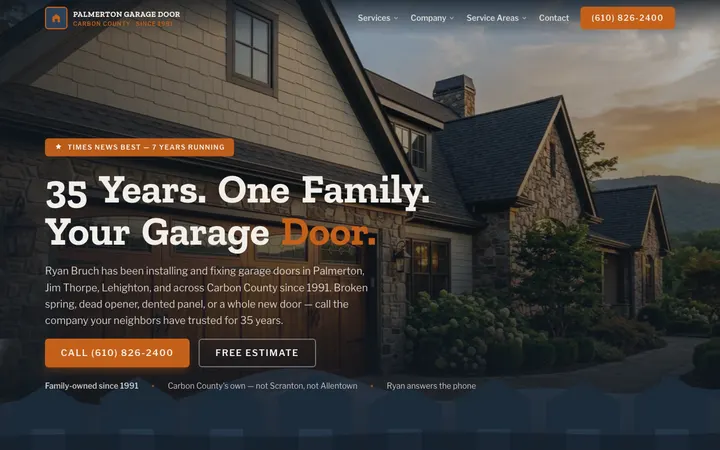
A family-owned garage door company, 35 years in business, with seven consecutive years of regional Reader's Choice wins. The existing site was a frozen seven-page builder template — roughly 600 words total, no ability to create custom URLs for services or locations. The award wins were not mentioned anywhere on it.
What the run built
- The award became the centerpiece of the brand — not a badge in a footer. The story: seven years running, in a county where word of mouth is everything, the same company keeps winning.
- 34 routes deployed. Seven service pages. Eleven location pages for Carbon County and surrounding towns. Four full blog posts.
- The scroll centerpiece: a worn, dented white garage door that rolls up as you scroll. Under it — revealed — a mahogany carriage door on the same house. At the midpoint of the reveal, a real customer quote appears: a homeowner who replaced three white utility doors with three mahogany carriage doors. The centerpiece is built around her actual words. The two door photographs are generated stand-ins, and stay flagged as such until the owner sends us his photos of that job.
- Entity cleanup: directories had been listing an old corporate entity instead of the current LLC, leaving NAP inconsistent across listings. Corrected.
Claims firewall in the built HTML
No license number, no “licensed and insured” language, no specific review count appeared in the shipped site. All of those were gated pending owner confirmation, and none made it into the build.
RUN 04 — POCONOS ROOFING
34/100
The certification on the site didn't match what the manufacturer listed.
A roofing contractor with an active website and a listed manufacturer certification. The site named a specific certification tier — the highest available — as a trust signal.
What the run built
- Cross-referencing the live manufacturer contractor directory: the actual certification tier was one level lower than what the site claimed. Not a fabrication — likely a misunderstanding of certification levels, or an old claim never updated after a tier change. Either way, the site was stating something the manufacturer's own records didn't support.
- That is a credibility problem if a customer checks. It is a legal exposure problem if a competitor notices.
- The claim was flagged before any Marketta copy repeated it. The corrected framing was used instead.
Four gates before anything goes live.
The cases above include five separate catches that had nothing to do with building something new — they were about finding what was already wrong.
- A GBP address pointing to the wrong town for years
- A CSS token collision that meant brand colors never compiled correctly
- Structured data on four blog posts that silently never rendered
- A contractor's credentials that looked expired on every directory (they weren't)
- A certification claim that didn't match the manufacturer's own records
None of these would have been found by a website builder, a freelancer on deadline, or an AI tool that starts from “what would you like your site to say?” They were found because the pipeline checks facts before it publishes them.
207 confirmed issues caught and fixed across two full adversarial QA runs.
Your build starts with a conversation.
Tell us about your business. We'll scope it and walk you through it.
$3,000 to build it. First month included. Then $149 or $349 a month, month to month.