
THE RUN, STAGE BY STAGE
You tell us about your business.
A specialist builds a finished presence on your own domain — brand, website, SEO, Google profile, content. You review it before it goes live. Then your employee keeps it current.
STAGE 00 — INTAKE
We start from whatever you already have.
You tell us about your business. If you have a website, we read it. If your only web presence is a Facebook page — that works too. In one case, we ran the full pipeline starting from nothing but a Facebook page and 279 job photos, downloaded before a word of copy was written.
Before the pipeline touches strategy or design, it ingests your existing photos, your old reports, your social posts, any brand materials you have. Nothing gets reinvented that already exists. Everything you've built — the reviews, the posts, the photos — becomes source material.
STAGE 01 — RESEARCH
Your whole online presence, scored 0 to 100.
Eight research streams run simultaneously. Your Google Business Profile — is it claimed, complete, categorized correctly, pointing to the right address? Your competitors — what are they ranking for that you are not? Your citations, your backlinks, your existing content, your reviews. And a newer ninth dimension when we check it: your AI Answer Visibility — whether ChatGPT, Perplexity, and Google's AI Overviews mention you at all when someone asks the question you answer.
Each stream produces a sub-score, and they roll up to a single Marketing Health Score — 0 to 100, letter grade, with a breakdown of exactly what is pulling the number down and what would move it fastest. The weighting adapts to who you sell to: a local contractor, a B2B firm, an e-commerce shop, and a nonprofit are not scored on the same scale. The businesses we have run scored between 11 and 35 at the start. Not because they were bad businesses — because nobody had ever looked at the whole picture at once.
You get a live, shareable report. A link you can open on your phone. Not a PDF, not a deck. A real deployed report with your score, your sub-scores, and the plan.
STAGE 03 — BRAND
A visual identity built for this business. Not borrowed from a template.
Three directions. A color palette that doesn't look like every other contractor in your county. Typography chosen because it reads as what your business is — not because it was the default. Voice and taglines written to sound like you, not like a marketing brochure.
You choose one direction. Everything downstream uses it: the website, the GBP cover image, the social graphics, the email templates. The brand is not a style guide that goes in a folder. It runs through the entire build.
STAGE 04 — WEBSITE
This is where the site assembles.
The research is done. The brand is locked. Now the pipeline builds. Every site ships with a scroll-driven centerpiece — a scene built from your real photos that moves as the visitor reads.
A tree-care company got a pine that grows as you scroll, built from his own Facebook photos — live load time 1.94 seconds, measured. A pole-barn builder got a building that draws itself as you scroll. A soft-wash company got a mossy roof that washes clean as you drag.
Yours is different because your photos are different and your story is different.
Every site includes
- Standalone Next.js site on your own Vercel project and domain — no domain yet? we'll buy one
- Homepage with the scroll centerpiece
- Individual service pages — one page per service, not a single-page dump
- About page with E-E-A-T signals: named owner, real history, verified credentials
- Location pages — one per town you serve
- Blog posts (4 at launch, written for AI search: direct-answer openers, question-format headings, FAQ schema)
- Full-site schema markup: JSON-LD on every page
- Ken Burns hero video built from your own job photos — no stock footage
- One-tap call and contact buttons on every page
- Review request system wired to your email
- Sitemap submitted to Google
Before launch — the adversarial QA pass
Ten-plus dimension checks on the built output. Not a checklist someone reads through — a system that finds the dead links, the misfiled schema, the address that leaked into the wrong field, the certification claim that doesn't match the source, then verifies each finding before flagging it. On two documented runs: 104 confirmed issues on one, 103 on the other. Zero false positives on the second.
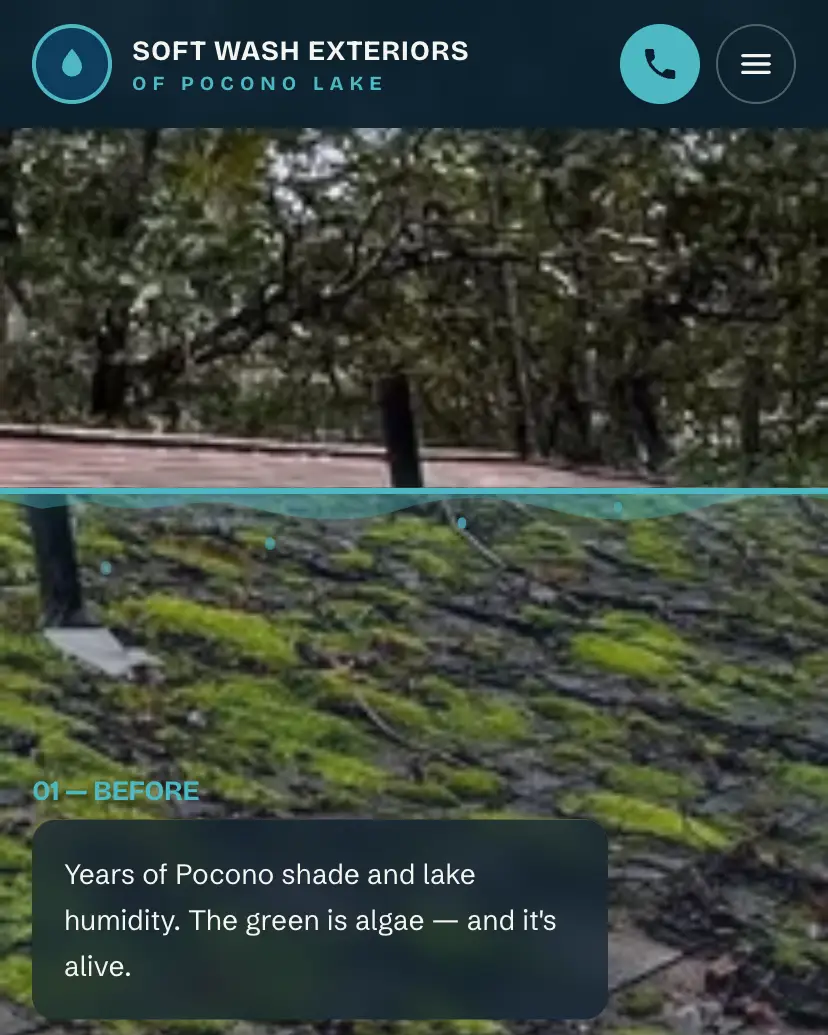
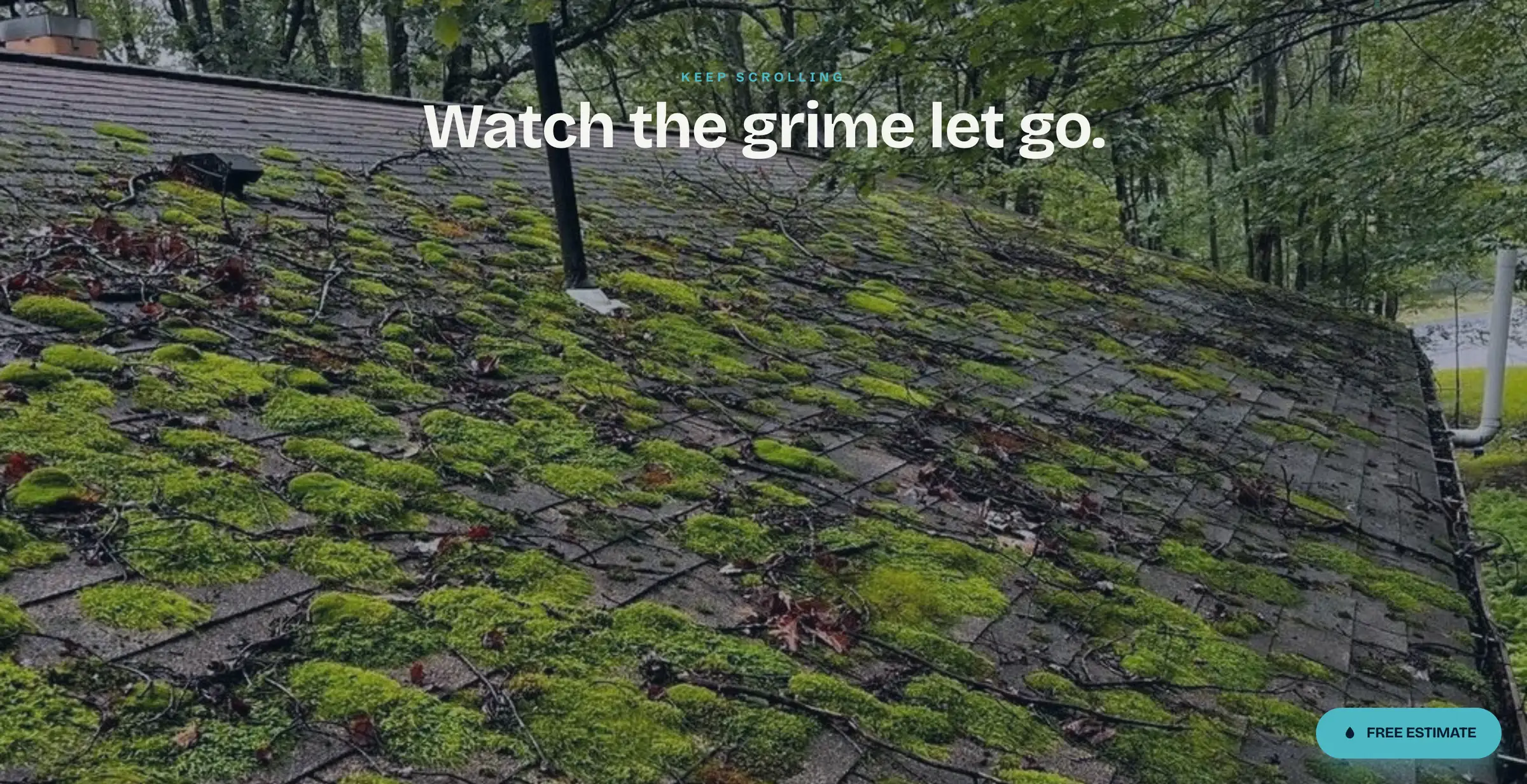
The wash reveal, built from a real roof on a real job.
// Soft Wash Exteriors, Pocono Lake, PA · built by Marketta · see it live →
STAGE 05 — SEO
Structure Google can read.
Schema markup tells Google exactly what kind of business you are, what you do, and where. A citation plan pinpoints every place your name, address, and phone are inconsistent across the directories that feed Google's local data — and exactly how to fix each. The groundwork Google needs to place you, done before launch.
STAGE 06 — CONTENT
Written to be found. Written to be read.
Service pages in the specific language someone in your county types when they need you — not the generic phrasing on every contractor's site. Blog posts written for AI search: each opens with a direct answer, uses question-format headings, and carries FAQ schema so Google, ChatGPT, and Perplexity can pull the answer verbatim. Plus a 3-month content calendar.
STAGE 07 — GBP
The listing Google shows before your website.
A keyword-rich description, the correct categories, four ready-to-post GBP posts, ten Q&A seeds, and a photo checklist — all written to the guidelines that affect local-pack ranking. A plain-language guide explains how to apply each piece.
STAGES 08–12 — SOCIAL · EMAIL · ADS · ANALYTICS · REVIEWS
What most pipelines skip.
Social: platform selection, posting cadence, the first month of captions, graphics sized per platform. Email: a welcome sequence, a newsletter template, three campaigns. Reviews: request templates in three formats, a printable QR card, response templates for every star rating. Advertising: campaign structures built in draft-and-paused state — no spend activates without your sign-off. Analytics: GA4 configured for the conversions that matter.
APPROVAL → LIVE
You review it. Then it goes live.
The run completes and you get to see the finished site — not a proposal, not a wireframe, not a deck. A real deployed site you can open on your phone and share with anyone. Nothing goes live on your domain until you've reviewed it and said go. Then it launches on your own domain and your first month of service begins.
We don't pitch. We build.
MONTHLY
After you go live — $149 or $349 a month.
You manage everything through the Marketta Hub. Ask for a change in plain English — a new service page, an updated price, a seasonal offer, a new photo — the agent drafts it, you approve it, and it publishes. Quick edits are uncounted, as many as you need; Lite includes 5 substantial changes a month, Standard 10 — and Standard adds a business-aware agent of your own, the full toolkit, and a real person on call.
FOCUSED RUNS
When you don't need the whole build.
The full run is the default. But the same crew and the same stages re-sequence around a single objective when that's all you need — whether you're an existing client with one problem to solve or a business that already has a site worth keeping.
GEO / AI answer
Get cited by ChatGPT, Perplexity, and Google's AI Overviews when someone asks the question you answer. Entity graph, speakable and FAQ schema, llms.txt — and a recorded check of whether those engines mention you at all, before the work starts and after it ships.
Reputation recovery
For a business whose reviews are in the basement or facing a one-star crisis. In-voice responses to the damaging reviews, a request system that builds velocity, and a target to overtake the local set.
Competitor displacement
You name the one competitor outranking you. We run a deep diff against them, rank the cheapest gaps that flip specific search and map slots, and close them.
Rebrand
A working business with an outdated identity. A new visual system, the site reskinned to it, and the brand rolled out across every surface — GBP, social, email — with nothing stale left behind.
Grand opening
A new business or location with no history to patch. The site and foundation built from scratch, plus a time-boxed pre-open push: waitlist email, opening-week social, GBP set to open on day one.
Seasonal campaign
A date-windowed offer for the installed base — HVAC summer, tax season, holiday retail. A campaign landing page, email, social, and paused ads, all on one offer, scheduled and measured.
Focused runs are scoped and priced to the work. Tell us the one thing you need fixed when you get in touch.
Start with a conversation.
Tell us about your business. We'll scope your build, walk you through it, and hand it over on your own domain — then your employee keeps it current.
$3,000 to build it. First month included. Then $149 or $349 a month, month to month.